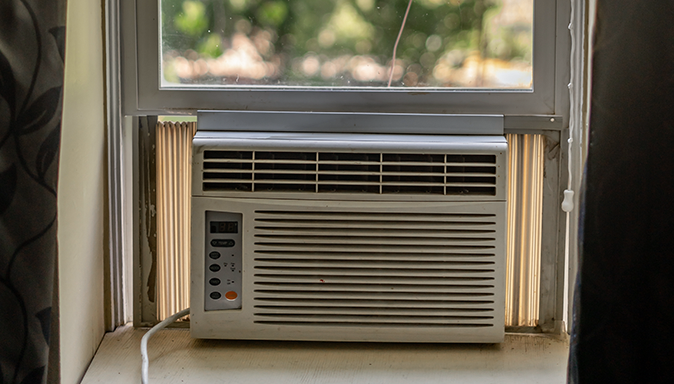
When hot weather hits, the last thing you need is a window AC unit that can’t keep up.
To keep your unit humming (and your energy bills in check) a little maintenance and a few quick fixes before temperatures soar goes a long way. Here’s how to give your window AC a simple tune-up so you can survive the hot and humid days ahead.
1. Clean or Replace the Filter: Start with the easiest fix first. A dirty filter restricts airflow, forcing your AC to work harder. On most models, the filter is located directly behind the front grille, usually in a slot at the top of the unit. If your unit has a reusable filter, rinse it with warm water and let it dry completely before reinstalling it. If it uses a disposable filter, swap in a new one. Make a note to check the filter monthly — you’ll get better airflow, cleaner indoor air, and lower operating costs with a clean filter.
2. Seal the Gaps Around the Unit: Because they are installed in an open window and not custom fitted to the space, window ACs are prone to air leaks all around the unit. Even tiny gaps can let cool air escape and warm air creep in, making your AC run longer and work harder. Take a close look at the sides, top, and bottom of the unit. If you see gaps or feel warm air coming in, add weatherstripping all around the unit. For larger openings, install adjustable side panels to create a physical barrier between the gap in your window and the outdoors. Watch this video to learn how:
For even better insulation, add foam insulating panels to block outside heat and reduce irritating rattling and vibration noises.
3. Insulate the Window Frame: Your AC unit is only as efficient as the window it’s installed in. If the window itself is drafty, you’ll lose energy even if you’ve completely sealed the air conditioner itself. Make your windows as energy efficient as possible by adding weatherseal along the window sash and frame to keep hot, humid air outside.
4. Clean the Coils and Exterior: Over time, dust, pollen, and debris builds up on your unit’s coils and fins, reducing airflow so your unit has to work harder to cool your room and shortening its lifespan. A quick cleaning every season will keep it running at peak efficiency. Unplug the unit and gently clean the exterior with a soft brush or vacuum attachment. Spray the coils with Frost King Air Conditioner Foaming Cleaner to easily remove dirt, grease and oil — watch this video to learn how:
While you’re cleaning the unit, check to make sure the AC fins aren’t bent and restricting airflow; if they are, use a fin tool to gently straighten them.
5. Use a Programmable Timer or Smart Plug: Smart AC use isn’t just about making the unit itself more efficient; cut back on energy costs with a programmable timer or smart plug that lets you turn the unit on before you get home and off after you fall asleep. This stops the AC from cooling rooms while you’re away, which will make a noticeable dent in your energy use over the course of the summer.
6. Pair Your AC with a Fan: It might seem like overkill, but running a fan alongside your AC can actually help you use less energy. Fans circulate cooled air more evenly so rooms reach your desired temperature faster. Once the room is comfortable, you may be able to turn the AC to a higher setting or cycle it off while the fan keeps the room comfortable.
7. Close Curtains and Blinds During the Day: Sunlight streaming through windows can quickly heat up a room—and that makes your AC work harder. Keep curtains or blinds closed during the hottest parts of the day, especially on south- and west-facing windows, to reduce heat transfer and help your AC maintain a steady temperature with less effort.
8. Revisit Your Unit’s Placement: Location, location, location: it’s true in real estate, and it’s true for your window unit too. If you’ve got flexibility in where you install the unit, choose a north or east-facing window to avoid direct, hot sunlight that makes the unit work harder.
9. Upgrade Aging Units: If your window AC is more than 10 years old, it may be using significantly more energy than newer models. While the fixes above will still help, there comes a time when buying a new air conditioner is the more cost-effective option. Newer units are designed with better energy efficiency standards and improved sealing. If your current unit struggles to cool your space even after a tune-up, it might be time to consider an upgrade.